
The story behind ZF Games
I think we left something at the arcade.
On Windows XP, “give it here,” and why I’m building Z Forgotten Games.

Mahmoud Hafez Mansy · Creator of Z Forgotten GamesMansy · Creator of ZF Games Also on Substack ↗
My friends call me Mansy. In Arabic, mansī means forgotten.
I grew up somewhere inside arcade machines and Windows XP, when a computer could contain your father’s documents, a suspicious number of toolbars, and an entire pinball table. Space Cadet was waiting there as if this were a perfectly reasonable thing to include in a machine purchased for work.
Zuma’s frog had responsibilities. The last brick in DX-Ball had apparently negotiated immunity. Minesweeper let you click once and immediately discover that you were unqualified for the position.
And somewhere in the room, someone was saying, “Let me try.”
That was how an afternoon disappeared.
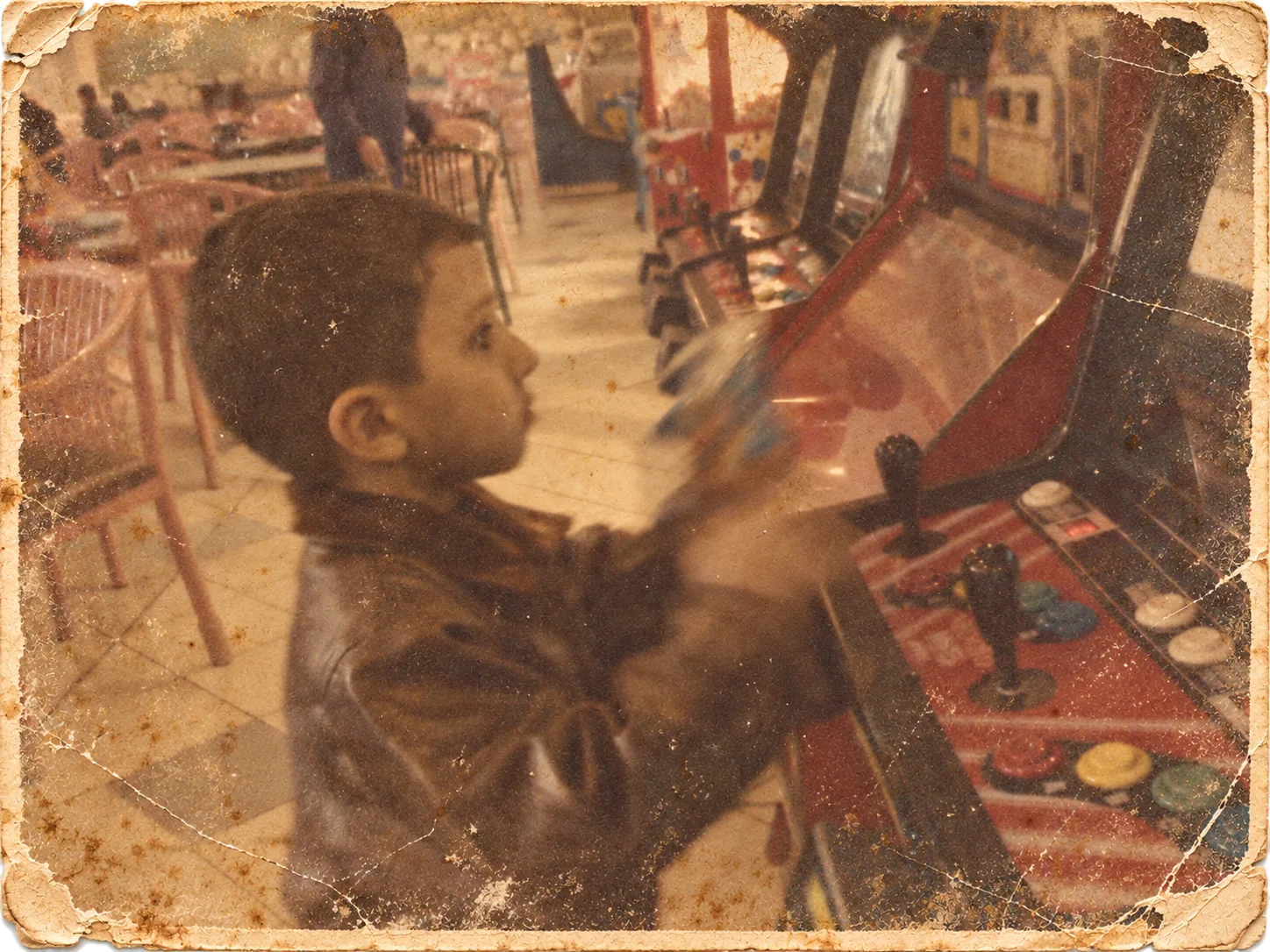
One chair became two. A third person stood behind us, offering advice nobody had requested. Two people shared a keyboard designed for one accountant, negotiating elbows, arrow keys, and which of us was responsible for the fact that neither character was moving.
Outside the screen, a domino struck the table with more conviction than the situation required. A missing chess piece returned as a bottle cap. A cousin explained the rules with the confidence of a man who would be revising them shortly.
We had very little equipment for the amount of world we were making.
A few pieces. A patch of floor. Someone worth beating.
And time, although we didn’t know to call it that yet.
I wonder what we were actually keeping when we kept those games.
I don’t remember most of my scores. I remember who leaned over my shoulder. I remember the indignity of losing to someone I had personally taught to play. I remember a move so bad that, years later, there are still witnesses.
A game gave us something to gather around. It made a small, temporary place where being clever mattered, being ridiculous was allowed, and “again?” was enough to keep everybody there.
Even losing had somewhere to go. Into an argument. Into laughter. Into a rematch you were absolutely going to win.
There was a peculiar generosity in a simple rule. Once somebody explained it, it belonged to everybody at the table. You could teach it to a friend, carry it to another house, scratch a board into the dirt. Nobody had to contact the person who invented chess before replacing a bishop with a bottle cap.
The game survived because people kept giving it away.
Of course, the arcade wanted our coins. The past had a business model too.
But I don’t remember the chessboard asking for my date of birth.
Somewhere along the way, getting into a game became its own little game, and a remarkably dull one.
Create an account. Verify your email. Accept notifications. Collect a reward for arriving. Return tomorrow to collect a reward for returning. Buy a handful of imaginary gems in a quantity carefully chosen to be almost enough.
I came here to move a little character across a road. Somehow I have enrolled in something.
Good games deserve to be paid for. People make them, and making things takes work. What troubles me is how often the pleasure comes attached to a system that seems dissatisfied with pleasure alone.
It wants a habit. A profile. A reason for you to feel behind.
“One more turn” is a lovely thing to hear from your friend. It feels different when an entire business has been arranged around making sure you cannot quite stop saying it.
I miss being allowed to finish a good afternoon.
Studying game theory and the philosophy of games brought me back to something I had understood with my elbows on a shared keyboard.
The rules can be small enough to fit in your head, and the possibilities can still be too large to hold.
Put a few coins on a table. Decide how many you may take. Suddenly there is a trap, a pattern, a person across from you pretending not to have noticed either.
Change one rule—whoever takes the last piece loses—and watch yesterday’s expert become today’s beginner.
Nothing on the table has changed. Everything worth thinking about has.
There is something beautiful about that economy. So much surprise from so little machinery. Mathematics you can get caught inside. Philosophy with someone impatiently asking whether it’s your turn.
And then the moment I love most: you look at a position you have been staring at for five minutes and finally see it.
The answer was there.
Unfortunately, so was your opponent.
I started building Z Forgotten Games in 2019, with two games to play.
The name carries a little of me, and a little of what I wanted to find again.
Some of these games are old. Some take a familiar idea and quietly remove the floor beneath it. They belong here because a good question does not become less interesting just because somebody first asked it a long time ago.
Can you win from here?
What happens if we change this rule?
Why are you smiling? What have I missed?
I want to give those questions somewhere to live. Somewhere you can open a page and begin. Free to play, with the code open too: look inside, learn something, make something, pass it on.
There is a certain affection in building a website that knows very little about you. You arrive. The game is there. That is enough for the introduction.
Bring someone beside you, or someone you wish were beside you. Give yourselves a problem small enough to share and interesting enough to forget the rest of the evening for a while.
Try a strategy. Become unbearably confident. Discover the flaw.
Request a rematch before your opponent has time to enjoy this.
This place is still taking shape. There will be experiments, mistakes, and more ducks than any reasonable person would have approved. I hope you find something here that makes you curious. I hope you send it to somebody with the extremely dangerous words, “I think you’d be good at this.”
Mostly, I hope a game becomes an afternoon, and the afternoon becomes a story that somebody remembers differently from you.
Maybe that’s what we left at the arcade.
Our scores are long gone. I’d like to hear “let me try” again.
Pull up a chair.
Old rules. New mistakes.
— Mahmoud Hafez, usually Mansy, ZForgotten
With thanks
To my Philosophy of Games professor, Joel David Hamkins, a mathematician and philosopher who taught me how much can be hiding inside a simple game. His teaching changed the way I look at strategy: a few pieces, a small rule, and suddenly something you thought you understood needs another look.
His presentations and mathematical analyses of games helped shape this site. For more of the thinking that inspired me, visit his publication, Infinitely More. There is a good chance you’ll arrive with one question and leave with several better ones.
Music
“Helios” by Lexica, courtesy of Epidemic Sound.